
Post
The Karmilovich Collection
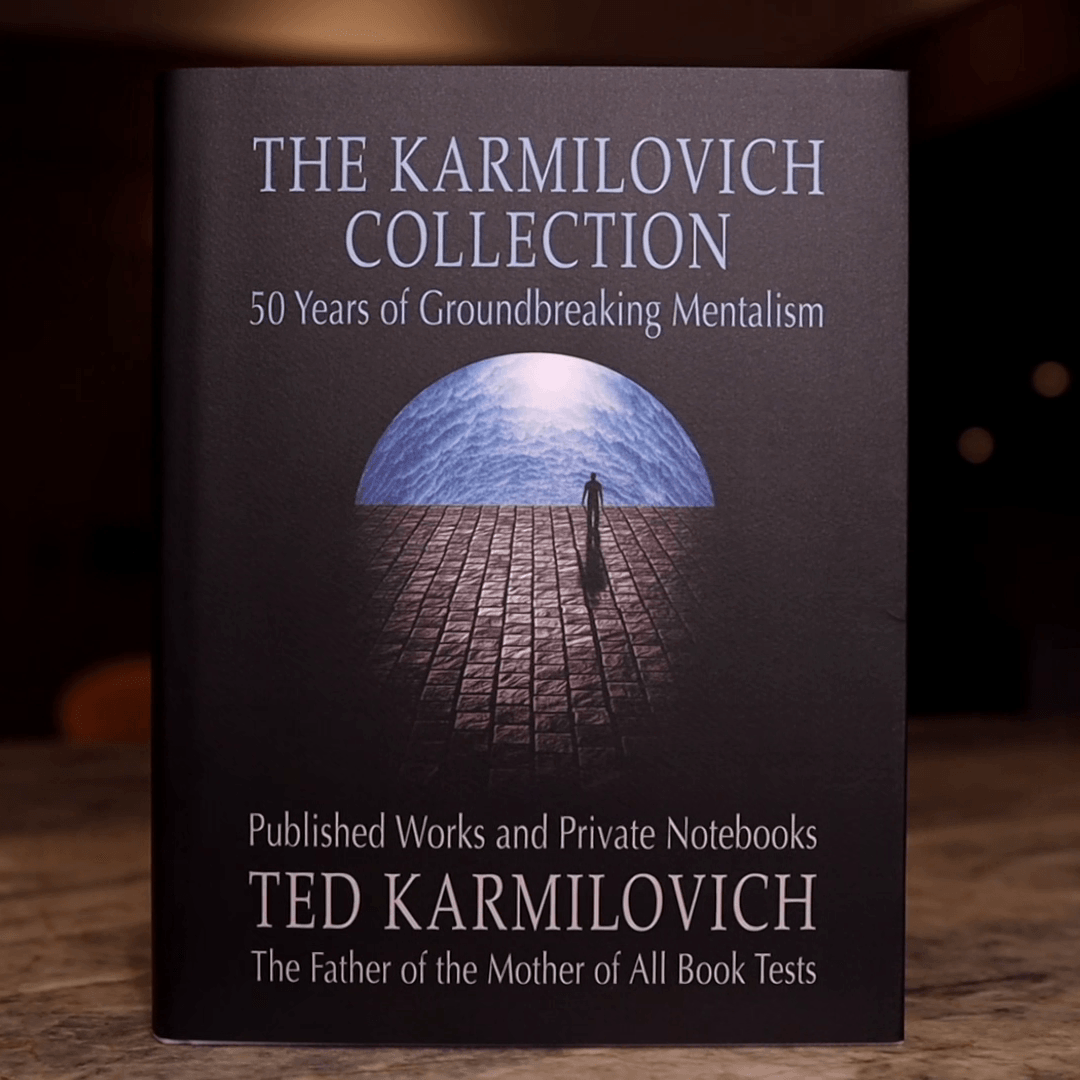
How do you even begin to review the life work of one of Mentalism’s biggest and most influential names in the past millennium? I mean just read the plethora of testimonials from other giants in the field on the product page and you’ll see this man was something special. His work influenced generations of mentalists. Rumors of this book started circulating in 1978 and now, in 2025, we finally get to read the book that many thought was just a fairy tale.
If you are a serious mentalist, you’ve probably already bought this. If you’re a hobbyist wondering if this is worth the price, I really can’t say. It’s a bit like owning a piece of mentalism history. Many of the routines are fully fleshed out and were clearly well worked by Ted. Equally many routines seem to be mere ideas that he never actually performed or only performed for his special group “The Thirteen.” The sheer volume of material here makes it clear that he couldn’t have performed all of them regularly. Odds are, he probably performed hundreds of the tricks a handful of times and a handful of the tricks hundreds of times. Some of them are clearly rooted in their time period. Some methods that were quite revolutionary in their time don’t resonate quite the same today. One thing I found slightly annoying as a reader was that there are SEVERAL effects that are described more than once in different contexts throughout the book. Many appear in the Magick section and then later appear in the “Private Notebooks” section as well (often referencing back to the previous pages as a reminder that you’ve already read this.) I wish they would have edited out the duplicate descriptions of effects because I often felt like I was having déjà vu.
With nearly two hundred effects, essays, and private notes across three hundred and fifty pages, I don’t have the space here to describe every routine. Instead, I’ll mention some highlights from each section.
Part One: Published Works
Three Billet Test - The performer correctly matches which of three billets a spectator will choose nine times in a row. It’s like an impromptu ESP matching effect.
This is one of Ted’s most famous impromptu tricks. You can do it any time anywhere with any slips of paper. It’s incredibly simple but that simplicity is part of what makes it so fooling. It’s great to keep in your brain for those moments when you’re unprepared. It’s a bit bold, but it really works. It has fooled even some of the most knowledgeable mentalists.
The Dime and Penny - The performer predicts who will be the most intuitive of the group with a simple dime and penny.
This is another Ted classic. It works very well in informal environments and feels totally natural. You do need a gimmick, but if you keep this gimmick in your pocket every day, you’ll have many opportunities to do something genuinely impressive. Again, it’s simple, but it allows for a very clean prediction of a person with a lot of interaction from everyone.
Murder, He Wrote - Many audience members grab a billet out of a brown paper bag. Everyone opens their billets. One audience member will have a slip that says “murderer” and one will say “victim.” The performer leaves the room with a committee and the “murderer” and “victim” come on stage and reenact a murder with props on stage. Once complete they head back to their seats in the audience. The performer reenters, holds the props used for the reenactment, and describes the murderer and the victim in exact detail via psychometry.
This is a huge routine that is built out of just a few small props. The method is simple and reliable, and allows you to demonstrate the “ability psychics use to help police.” The theatricality is really the star of this one. It’s a masterclass in pack small, play big.
The No Prop Nightclub Act - With absolutely no props the performer reveals three people’s star signs, transmits a couple of numbers to the audience, and answers several specific questions from audience members that they only think of.
This show uses a really clever method to reveal starsigns. It is a strong method that you can incorporate in different ways. The number transmitting section is classic psychological forces, but they fit nicely in this set. The Q&A portion is the most bold and requires some casual preshow, but the effect you get in performance is really astounding. Perhaps it’s TOO perfect and leads to the only possible explanation as the accurate one, but if you have an audience that really believes what you’re doing, they will be hooked. It’s all easy to do methodologically, but takes real performance chops to make it entertaining. Would I ever perform the act as written? No. But it’s still inspiring to read.
Hellstromism - This section deals with legitimate contact reading to find hidden objects.
No tricks here; this is the real thing. This is a tough thing to practice because he says it can really only be done with strangers, but I enjoyed reading the finer details of how to make it successful.
Target Number - The whole audience takes part in an experiment of thought projection. The performer predicts the exact clothing the “winning” person will have.
In my opinion, this is Ted’s best thing. I use a version of this in almost every show I do. Like everything of his, it is simple but effective. This section covers several different methods that each have their pros and cons. There’s some really great ideas in this section including how to make it seem like your prediction is even more impossible than it really is.
Impossible Princess - This is Ted’s tossed out deck with an ordinary deck.
I had to point this one out because I have used it in several shows in the past. It’s a really easy and strong way to get a TOD type effect with a normal deck. It is a little more limiting than the usual TOD because of the method used, but it’s a great trick to have in your head in case your luggage doesn’t make it to the venue or you have to quickly add another set with the current items you have.
The Ten Card Miracle - A deck is shuffled by the audience and ten cards are passed out to audience members. The performer names each card the audience members are thinking of ending with a prediction of what the final card will be.
Another absolute killer from Ted. I know I sound like a broken record, but this is so easy to do. It’s the epitome of K.I.S.S. (Keep It Simple, Stupid) but it plays so big that it can fill the largest of venues. It’s also practically self-working. It’s another routine that feels similar to Tossed Out Deck with a normal deck. If I had to choose between this one and the previous routine I mentioned, I would use this one for larger crowds and the previous one for smaller crowds. But truly, as long as you have ten people in attendance, you can do this.
Now is the Time - The performer predicts the exact time an event will occur.
I had to read this a couple of times to fully grasp what was going on here. It’s kind of hard to explain, but basically, it’s a clever combination of methods that allows you to predict the exact moment something will happen. I mainly wanted to point it out because it’s an interesting method. It reminds me of the classic “trick that fooled Einstein.” You would have to get a watch altered to work for this, but in a casual situation I think this could be fun. I’ll never use it, but it really shows the unique way Ted thought.
Vision in Black - A spectator makes a drawing and sandwiches it between two opaque boards. The performer can reveal the image however they want.
This is a clever peek of an 8 x 10 inch drawing. The choreography is completely logical and the drawing never leaves their hands. It’s a really nice idea that could challenge a lot of modern day tech devices.
Psi-Eye - This is a unique business card peek.
The unique thing is that the thought is written on the business card while it is held behind the performer’s back. The business card is folded with the word inside while it’s behind the back, and as soon as it’s brought around to the front, the performer knows the word. Again, the method shows Ted’s ability to think outside of the box.
Mother of All Book Tests - Ted’s biggest gift to the mentalism world. His book test revolutionized all book tests that came after it.
If you’ve ever had a book test that allowed your spectator to “think of any long word” then you have used Ted’s brilliant principle. It’s hard to even imagine a world of booktests before his because his was so monumental that it completely shifted the landscape of book tests. Nowadays, virtually every new book test contains Ted’s MOABT principle. I couldn’t write a review of his life’s work without pointing out this major contribution.
Part Two: Private Notebooks
Air Horn - This is a russian roulette routine with airhorns being blasted towards the performer’s ear. Three air horns have been emptied of their air, but one is “fully loaded.”
The method isn’t really exciting here, but the concept of a russian roulette with air horns is great because it’s super loud and it seems like something you would actually risk (your hearing) instead of risking your life or risking being impaled.
Four Color Epic - Using three index cards and one of those four color pens, the performer reveals three thoughts.
This is a great version of the classic mental epic for close up. The four color pen allows you to write each spectator’s prediction in a different color and it has a great convincer of you writing their number (in the appropriate color) on the outside of the folded index card. It’s quite fooling.
Mental Rental - Three letters and three numbers are called out by audience members. The performer pulls out a set of keys for his rental car, and the license plate number written on the key tag matches the letters and numbers just selected by the audience.
This is a cheap and easy way to get a prediction onto your keyring. It’s a solid piece that you could go out and use ASAP.
Shredded Bank Night - The performer shows three sealed envelopes and explains each contains a folded piece of green paper. The performer removes his wallet, takes out a $100 bill and seals it in a fourth envelope. A spectator mixes all four envelopes and she numbers them 1-4. Audience members call out three numbers and each envelope gets shredded leaving only one envelope. It is opened and it contains the $100 bill.
This is a bank night with a funny method. It’s dead easy to do and it really is as clean as described. There are literally no funny moves or strange moments, the handling is totally fair, and it’s entirely self-working. The kind of silly method is what makes it so clean.
Two Bowl Q&A - The audience members each have an index card and golf pencil. They tear their index card in half. On one half they write their name and a question they want the answer to, and on the other half, they just write their initials. The question cards are gathered and dumped into a clear bowl on stage. The initial cards are then gathered and dumped in a second bowl on stage. The performer draws out one of the initial cards, reads out the initials, and has that person stand. The performer then looks into their eyes and begins to answer their question. This can be done with five or six people.
I think this is genius. It’s a clever way to gain access to the questions right under the audience's noses and all of the moves look totally natural. You could easily build this into a full Q&A act.
What’s my fourth dimensional sign? - Three thoughts are written and sealed in three envelopes. The performer reveals each thought.
This is Ted’s way to perform a 4th dimensional telepathy routine without needing a force or impression device to get one behind. It’s very smart and so obvious that it seems like someone has surely published it at some point, but I’ve never thought to do it. It really cleans up the routine.
Part Three: Ends and Odds
This section doesn’t contain any magic. It contains a transcribed interview with Ben Cummings, a transcribed interview with Michael Weber/Promystic, Ted’s short autobiography, Will Fern’s on Ted’s life, Docc Hilford’s on what he learned working with Ted, Roy Miller on the history of “The Thirteen,” alternative cover designs, a photo gallery of Ted’s personal life, Ted’s business card designs, poster design, T-shirt design, postcards, several newspaper articles about him, and some final words.
Overall, I think there is a lot of great material in here, but you have to dig for it. This isn’t like most modern magic/mentalism books where all of the fluff gets edited out and only a handful of routines get described in depth. Here, you get everything, fluff and all. Every little idea and every beginning seed of a routine is described. There’s even a whole section that just shows ideas Ted has posted on the MagicCafe. It’s literally everything he ever even thought about creating. Because of that, I would say this book is definitely not for the beginner mentalist. If you’re just now getting into mentalism, this book will be overwhelming. You need the ability to know how a routine will play to decipher the more mediocre ideas from the great ideas. Nevertheless, the book is a look into the mind of a prolific creator who has genuinely changed the world of mentalism for the better.
The Karmilovich Collection is available from Penguin Magic for $250 here:
Never miss a post! Subscribe now!