
Post
Memoraid by Chris Rawlins
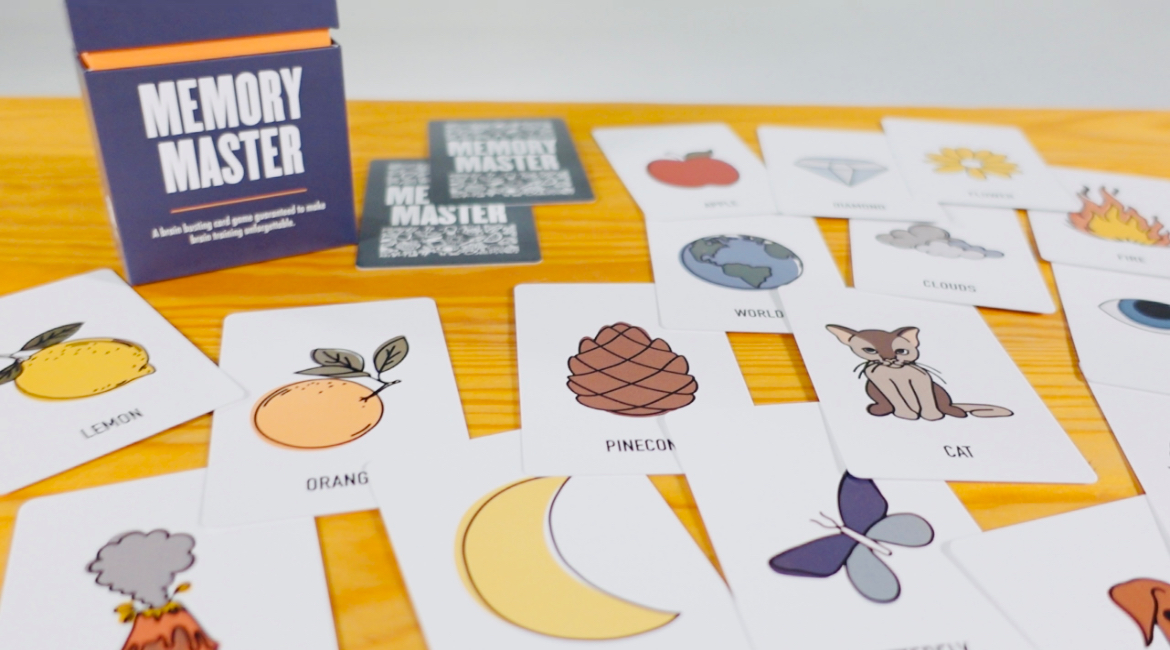
Chris Rawlins has been putting out some very strong magic and mentalism lately and this trick is no different.
Memoraid is a deck of cards that is designed to look like a memory game. The quality of the box is top-notch. It is built to last, and it looks exactly like something you’d find at a gift shop. The cards themselves are images printed on a very nice bridge-sized card stock and what appears to be a linen finish. Half of the cards are full colored images and half are black-and-white. The back of the cards are marked to tell you what is on the face, but they are also marked to tell you specific properties of the image–this comes in handy for one of the routines. The back design is composed of all of the images from the faces scattered about, and while I don’t think a spectator will notice the markings, as a magician, when I first opened the deck and spread through them, I immediately noticed the markings. I think it’s just because I knew where to look, but that said, I wouldn't feel comfortable handing this deck to a spectator for them to examine for a long time. In the course of a routine, I don’t think anyone would notice the marks, but it’s not a deck I would leave out for them to compare one card to another.
In the deck, you get 50 memory cards and two instruction cards. One instruction card teaches you how to play the real memory game that you can play (and cheat at.) The other instruction card walks you through “The Ultimate Memory Test.” The idea is that you would have a spectator read off the steps on this card as you perform the three-phase routine. It fully justifies the three-phase routine and provides a rationale for the actions you have to take in the routine.
The tutorial is just under 90 minutes and covers a wide range of applications for the deck. It begins with an intro, a history of the deck, and credits. Next Chris goes over the prop explaining the markings and the way the deck works. Next is a brief section on how to use the deck and some ideas on when to read the mark.
This leads us to a full performance of the routine “The Ultimate Memory Test” and right into the explanation of how to perform this routine. It is three phases that begin with a genuine memory feat (although, you can fake it if you want,) an impossible separation of the cards, and ends with you nailing the image that was put aside at the beginning. The markings do all of the work for you in this routine. The only time you need any real memorization is in the first phase, but as mentioned, if that seems too daunting, you can also fake the first phase. I highly recommend everyone to learn how to do the first phase for real though. It’s not difficult at all once you’ve got the main method down, and it makes the rest of the routine feel more real.
The next routine is “Grid Memory.” We get a full performance and then an in-depth explanation. It’s another three-phase routine, but to me, this one seems almost too believable to be entertaining. Everyone won’t feel that way, but for my taste, I think this is lacking a little bit of the impossibility factor. It only uses a dozen or so cards, and there just isn’t a punchy moment that really takes this into a magical territory. Now obviously, you can mold this however you want, and you could easily change a few aspects to take this routine into impossible territory, but as it is, it feels TOO real. It’s a well-choreographed routine, and it’s very easy to do, I just don’t think it’s as strong as “The Ultimate Memory Test.”
The next section has Chris teaching you how to play the actual game and how you can cheat at it. Honestly, I was expecting this to be a better game that multiple people could play against one another, but really, the game that comes with it is just seeing how many cards you can memorize. It wouldn’t be a very fun game to play in a group. Luckily for us, we aren’t buying the cards for the game, we’re buying it for the routines.
Chris then moves into how to use this deck for mind reading. He teaches a few different ideas including how he uses this strolling for mind reading using only the colored cards. He also teaches his “Linguistic Svengali” which is a clever principle built into the deck. Essentially, it is a stack that allows you to get three hits before you even read the mark on their selected card. It gives you the freedom to delay the peek.
The bonus section is a rapid-fire section where Chris details ideas he has used with the deck. He discusses doing memory in a stand-up environment, a presentational element that provides a framework for memory, splitting the one deck into two decks, a peek with the box, a peek across the room, using the deck for the amazing memory test, using the cross cut force, out of this world with the deck, Miraskill with the deck, and a hidden one-way mark.
And that ends the tutorial! It is clear that Chris listened to the feedback of his other releases and worked very hard to keep this tutorial as short as possible. I am very thankful that he chose to speed through many of the ideas rather than belaboring the point.
Overall, the deck is of great quality, it appears to be a real memory game, and it’s worth buying for “The Ultimate Memory Test.” The other routines and ideas are all good as well, but ultimately, the deck is a tool that will allow you to be creative and do anything you could do with a marked deck. I will definitely be using it. Those who are Jerx fans will see that this deck fits nicely into the E.D.A.S. framework especially if you incorporate the memory presentation framework that Chris discusses in the rapid-fire section. I’m already putting together my thoughts on how I’ll use it, and I’m looking forward to having it on display. It is superb quality for the price.
Never miss a post! Subscribe now!