
Post
Extra Plots & Methods by Michał Kociołek
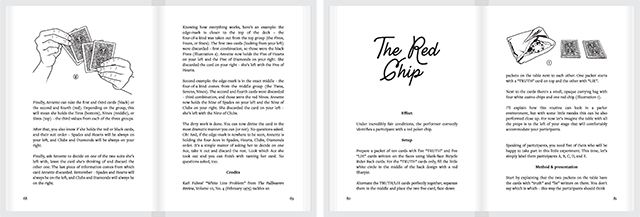
This is the third volume of Michał’s Plots & Methods series. It’s a book of 11 card effects. The thing that became immediately obvious as I was reading is that Michał is a very smart guy. These effects all have a clever structure/method that is impressive “under the hood.” I found myself saying, “that’s clever,” very often as I was reading. As such, you’ll also see me say that several times in the trick-by-trick breakdown.
Introduction - The introduction contains a hidden trick utilizing a full suit of cards and the down under deal to create a clean prediction of a freely chosen number that is rolled on two imaginary dice.
The effect included here is a clever use of the down under deal to not only force a card, but to also position a card in the perfect position to be palmed out. It’s a simple sequence, but it even feels kind of magical when you do it yourself. It’s not a show stopping moment, but it’s nice.
A Number, A Card, and A Shuffle - A freely selected card ends up at a chosen position in a deck haphazardly mixed face up and face down by the participants.
I like the thinking here. The smartest part is that the card is already controlled to the correct number in a faceup/facedown mixed deck, then you allow the spectators to shuffle the deck, and yet the card will always still be at the correct number even though the shuffles are 100% legitimate. It’s a really clever use of the situation. The way he controls the card to the number is also easy and happens on an offbeat. This is my second favorite from the book.
The Missing Piece - The participant’s card, chosen under incredibly fair conditions, completes the performer’s Royal Flush hand.
This requires a full deck set up. Well, really, you’re only putting four cards at specific places, but you couldn’t really set it up while people burn you. Again, the thinking here is clever. As always with these types of tricks that require a full deck stack, I think the trick is only as good as your false shuffle. The audience MUST be convinced that the deck is shuffled. There’s an alternative handling in the book that I prefer to the main one because it makes the set up much more manageable to do in real time after the spectators shuffle the deck. The really fooling part is that the spectator gets to choose how many hands of poker to deal 2, 3, 4, 5, or 6. They remove the highest card from their hand, and it will always match your royal flush from another deck. There’s no switching of the selected card; it legitimately does complete your royal flush. As it’s written, you will need an envelope or wallet or something to keep the royal flush cards in, but the alternative handling can have the hand sitting on the table from the beginning. This is my favorite routine in the book. It’s very clean.
Signed & Delivered - A one-at-a-time assembly using only the four signed Jokers and four blank cards.
This uses a discrepancy in a smart way to make the first assembly super clean. The jokers are signed which means you’ll need to replace the jokers each time you perform it. My one critique of the routine is that the first three phases happen in exactly the same way. I wish there was some variety there to help hide the method a bit, but it gets the job done. The discrepancy is also cleaned up in a clever way by making the final assembly happen in their hand even though they clearly “see” that it’s the joker until the last moment.
Synergic - The performer finds the participant’s card and vice versa.
This is a very smart method, but I don’t think it adds much to the plot from a presentation stand point. The cleanest way is still to use a marked deck or be able to clock the deck. This version involves a 27 card set up along with a crimp and pencil dotted card. It’s a lot of setup for a trick you can just use a marked deck for, but if you want to do that trick, this is a fun method.
50/50 Poker - The participant wins a game of ten-card poker with a hand he chose before the game even began.
To be clear, the spectator names what kind of poker hand they want (such as three of a kind), and you take turns drawing cards from the ten cards. They will always end with their chosen poker hand. I know I’m a broken record here, but once again, it’s a smart method. It’s just not one I’d ever use. It takes a bit of memorization to know how to get it to work with their chosen hand. He also teaches a follow up effect where the chosen hand changes into a bad poker hand, and the chosen poker hand is removed from five different pockets. It's super clean because there's no palming necessary; it's as clean as can be. The method totally works, and it’s certainly interesting to let them choose their hand before you play the game. If you’re willing to put in the bit of memorization, you’ll have a nice trick.
Poker Player’s Dream - Without any manipulation, the performer deals himself the highest possible hand of any poker rank named by the participant.
This is another trick with a full deck stack and a bit of memory work to be able to quickly recall how you get to the named hand, but it does allow you some freedom. Michał is using some ambiguity to tell the spectators what is going to happen but not exactly how it’s going to happen until after they make their choice. This means the majority of the method is in your words and not your actions. There are only two cases where you have to do a single second deal. In all of the other cases, the cards are dealt cleanly. Your audience does need to have a general knowledge of the poker hand rankings and Texas Hold’em for it to make much sense.
No Questions Asked - The performer correctly divines the participant’s card, chosen under incredibly fair conditions. No fishing. No questions asked.
This is another full deck set up and it is INCREDIBLY clever. Perhaps one of the most clever ways I’ve seen to know a thought of card. The issue is that it’s a lot of work just to know what card someone is thinking of and they are limited to not think of the court cards. It also takes quite a bit of memory to know what card they picked. Essentially, the spectator is unwittingly cuing you their card by the actions they take as they remove their four of a kind and eventually their chosen card from that. It reminds me of a Michael Murray effect from many years ago. There also seems to be a slight chance the spectator could accidentally screw it up if they aren’t proficient at handling cards. If they accidentally go past one of the four of a kind as they remove them, it will make the rest of the trick fail. But again, super smart and unique!
Opposites - The participant stabs a card in the deck next to her previously thought-of card.
Once again, a full deck stack is used (a version is also taught with an eight card stack.) This is sort of Michal’s version of Out of Sight Out of Mind. The spectator thinks of a card they see and they remove the complete opposite of their card (so if they are thinking of a black court card, they remove a red spot card, etc.) They then insert that card into the deck, and you show they have stabbed it right next to their thought of card. This is similar to the previous effect in that the opposite card they remove cues you to the card they are thinking of. It feels a little too random to me, and again, a bit too much memory work. I have to ask if it’s any better than just having a card peeked at from a riffle or a card selected. In both of those cases, this could be done with a borrowed, shuffled deck.
The Red Chip - Under incredibly fair conditions, the performer correctly identifies a participant with a red poker chip.
Using ten cards with TRUTH/LIAR, five spectators each pick one of the cards and a chip and take their place on the stage. The performer asks each if they have the red chip and each plays the character on their card when they answer the question. The performer is able to find who has the red chip. Michał even says this is best used as a lead in effect to something bigger. It’s a workable method and a clever use of a classic principle. It does feel slightly underwhelming though. I agree that it needs something else afterward. I was actually really excited when I first started reading the method because there’s a really verbal dodge that makes it seem even fairer than it really is, but the way it ends up working out is not quite as clean as I hoped.
Epilogue - A hidden triumph effect
The effect in the epilogue is an interesting version of triumph that is meant to be performed after a trick that leaves the spectator with five cards. They mix their five cards, think of one, and those five cards are returned to the deck. The deck is shuffled face up and face down and only then does the spectator name their card. The deck is spread and they will see their card is the only one reversed in the deck. It’s a unique take. I like the idea.
Overall, there’s some really good thinking in these pages. Michał has a very unique approach to card magic that sets him apart from others. As a bonus, when you purchase the book you get access to the instructions for Michał’s previous release, Misdeal.
The book is available for $49.95 at the link below:
Never miss a post! Subscribe now!