
Post
Evidence of a Well Spent Life by Helge Thun
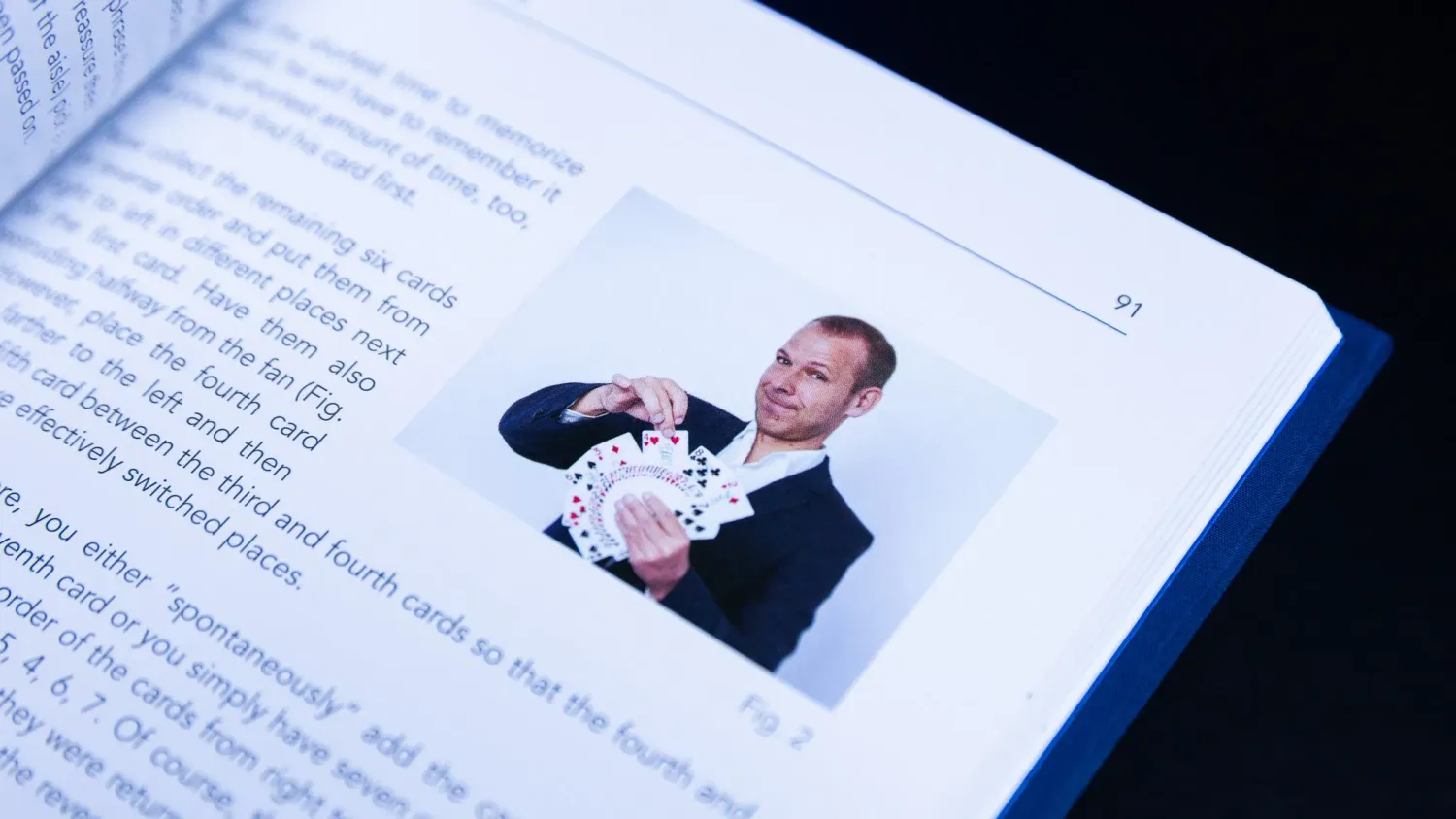
This 175 page book is my introduction to Helge’s work and his first book in English. I was surprised to find that there were some gimmicked cards included in the back cover of the book which is a unique way to sell a book/gimmicked cards combo. It made me smile. Because the cover has to be thick enough to hold those cards, it means the front and back covers are a little thicker than normal, but the cloth linen on the cover feels and looks great. I thought it was nice that they included the cards to be able to perform the last few routines. The book is what you’ve come to know and love from VI with high quality photos, paper, layout, and editing. Helge also has a writing style that is entertaining to read.
The book begins with a Foreword by Guy Hollingworth and an Introduction by Helge Thun where he explains the themes of this book: stand up parlor magic with signed cards and complex routines with signed cards. He suggests that putting selected cards in impossible places is more memorable than most other card tricks. Helge likens the type of card tricks he enjoys to the cups and balls; he is constantly on the endeavor to find and create card magic that has the multiple reveal finale that a cups and balls routine has. Reading his thoughts here really made me excited to continue reading the book.
Chapter One: Single Cards
Instant Camera Card - Instead of finding a spectator's signed card, you take a Polaroid photo of her thoughts with the deck's built-in instant camera; three seconds later, it develops into a clear image of her card. Even the signature is quite accurate.
This is my least favorite effect in the book, but it’s a routine Helge has been working for 30+ years. I can’t really explain why I don’t like it other than the fact that it just seems a little too kitschy for my liking. The visuals look a little too much like you’re just pushing a card out of the deck with your fingers which is basically what you’re doing. It’s cute, but not super magical to me.
Bulkoki Reloaded - A small denomination bill turns into a hundred and finds a previously signed card in a closed card case by wrapping itself around the card.
This routine made up for the bit of disappointment I felt with the first routine. It’s a very simple method, like, kind of silly how easy it is, but the impact is really large. The moves all happen naturally and the ending is set up at the very beginning. There’s some really great use of humor to hide deception (more on that in the next section.) It just seems like such a fun routine to do.
Humor as Deception - This essay goes into detail about why and how Helge uses humor to hide methods in the previous effect. The borrowed bill is confirmed to be the same via serial number instead of a torn corner or signed bill, and at first, that may seem less impressive, but this essay explores why it’s equally or even more impressive. What seems like a joke eventually becomes the convincer they didn’t even know they were buying into. It’s really great thinking.
Chapter 2: Technique
This chapter explores some useful moves such as his Action Fan Palm that allows you to palm a card as you close up a fan, The Bent Cop Transfer which is a handwashing sequence that allows you to show both hands clean while palming cards, three methods to load a Card in Mathbox which is important to know because several routines that follow use one or more of these methods, and a section called “Hands up!” which discusses several ways Helge holds the deck to keep things appearing fair.
Chapter 3: Beauty of Complexity
Better Safe than Sorry 3 - Despite a rubber band for added safety, three signed cards are found. Even adding security measures (card case and handkerchief) does not prevent the repeated success during the second round. The last card even appears folded into quarters in a small, transparent plastic box filled with rubber bands. It is also secured by one of the rubber bands, which is wrapped around it twice in a crosswise fashion.
This is such a great routine. Helge uses natural moves as he shows one card to get ahead meaning that all of the action is justified and nothing feels out of place. The way the final card gets wrapped in a rubber band is so clever. I love the structure of the entire thing. It’s virtually perfect. This is my favorite routine in the book and one that I will definitely do.
Strangers or Friends? - This is an essay on how to treat spectators on stage, and the information given here is something every performer should read. There’s nothing worse than seeing a performer handle spectators poorly onstage and embarrass them the whole time. So many magicians get a cheap laugh at the expense of the person on stage. Here, Helge provides great advice to actually talk with the spectators as humans and give them all of the power on stage so that they are completely comfortable.
The Flying Four - The left hand holds a deck of cards face up in a perfect fan. One after the other, three Aces shoot out from the fan, are caught in midair and placed in different positions halfway into the fan. When the last Ace is also supposed to fly out of the fan, it appears sticking out from the remaining free position in the fan.
I’m not a huge fan of this; I think there are much better four Ace productions out there. This one is a bit knacky and repetitive. It’s not BAD; it’s just not GREAT.
Eight Ahead! - Four signed Aces are found, turned into four Kings and then are caused to appear immediately in four impossible locations: in the card case, your wallet, a matchbox, and a new, sealed deck of cards.
The routine is aptly named because as the performer finds the four signed aces the first time, he gets eight ahead giving you eight strong, unexpected hits of magic without any moves. This is another one of my favorites from the book. Again, you’re setting up for the finale so early and naturally that no one stands a chance of backtracking how any of the cards make it to their final resting place. One note is that even though the effect description reads that the last card ends in a sealed deck, he doesn’t actually teach how to produce the last card from a sealed deck. He teaches how to make it appear sandwiched between two jokers which brings the routine full circle, and at the very end mentions you can have the last card appear in any impossible location “for example, from a sealed new deck as in the effect ‘Fully Loaded’ by Mark Mason.”
Pockets Full of Presents - Seven signed cards are produced from a shuffled deck. As a thank you, all volunteers receive a gift. In each of the performer's pockets there is a little souvenir. It's the same signed cards, which had just been found and lost in the deck again. The seventh and last card is even found folded inside a matchbox.
This is essentially a multiple selection routine, but as you find the cards during the first round, you’re also loading other cards for the surprise “kickback.” This means that at the “end” of the trick, you give the deck away, and with no moves you’re able to pull six of the selected cards out of six different pockets and the seventh folded in a matchbox. Again, great structuring. There’s also a big tip about how to make the selection part of the trick very fun, interesting, funny, and memorable instead of that being down time while the audience waits for the trick to get started. That tip alone is worth the price for anyone consistently using multiple selection routines in stand up situations.
Chapter 4: The Duplicate Principle
The Signatures - The process for obtaining a duplicate signature.
It’s a really clever use of an old gimmick to give you a duplicate. As the ad copy says, it’s not a forgery, imitation, or impression. It’s genuinely their signature on the card. Of course, there’s a bit of a catch. The catch is how you can use it and what cards you can duplicate the signature on. You also have to have four cards signed to get a duplicate. I actually think the best way to use it is to have the cards signed, do a quick trick with those, shuffle them back into the deck and much later in the show, have someone “accidentally” pick the already signed card and then you can launch into whatever impossible trick you want with that signed duplicate. Helge gives us many ways to use it in the coming pages, though.
4 Card Brainwave - One signed King in a packet of four is reversed behind the back. The audience now freely names one of the Kings and, as it turns out, it is the one predicted.
And that's not all. You were apparently so sure of yourself that you marked this King with a large mark on the back before you started.
The point of this is to provide a reason for signing the kings, do a quick trick which eliminates half of the cards, and leaves you ready to use the duplicate. It’s not the most impressive trick (a one in four chance) and it requires a bit of equivoque, but it’s not really meant to be a showstopper. Its sole purpose is to give you a duplicate signature ready for the next trick.
Free Choice - Give the spectator a choice of which card to use.
This is a simple touch that allows the spectator to randomly choose which of the remaining Kings you’ll use for the “main” trick, but this process secretly allows you to ensure you’re always using the card you need. It can be used after the previous trick or it can be used as a convincer with any other trick you do with those four Kings.
Cornererd - A signed King is torn into four pieces. The pieces disappear except for one corner and the card reappears restored in the deck with the exception of that corner. The card is then torn a second time and after the pieces have disappeared again, the card reappears in the deck once more. This time, however, it is completely restored.
This takes care of the biggest discrepancy of the duplicate signature method in a really clever way. It’s a strong trick that feels like it reaches an end, yet, if the spectator asks if you can restore the last corner, you have a killer moment that is truly impossible. It’s a very clean TNR, but I prefer the visuals of “Filling the Gap” which is coming up.
Round the Corner - A reminder that the final signed card can appear anywhere.
This is a simple suggestion that instead of causing the fully restored card to reappear in the deck at the end, you can load it wherever you want.
Filling the Gap - As in "Cornered," but after the card has been incompletely restored for the first time, it is not torn again. Instead, the missing corner is thrown against the card, which visibly restores in a split second and without any cover. The signature is visible the whole time.
I really like the visual that this adds at the end. It makes the routine even a little simpler to follow for the spectators. I think this is the best approach if you can coax a spectator into asking you to restore the corner. It requires an additional gimmick for the flash restoration, but that gimmick is very easy to make, and I think it’s worth it. I would have been very fooled by this.
The Cloth of Death - Four signed Kings are shuffled into the deck and found with the help of a silk handkerchief
This is another “first” effect you can do with the signed Kings before using the duplicate principle. It’s a nice way of finding the four Kings where each production feels very different than the last one. It is a bigger trick than “4 Card Brainwave,” and I think it provides a little better justification for why the Kings are signed. Then after this routine, you’re ready to go into any trick with the duplicate signed card. I would use this routine, shuffle the kings back into the deck, and use the idea I mentioned earlier of having one of those Kings “accidentally” chosen at a later point in the show. It sets you up so far in advance that you could literally do the most impossible magic you could think of. But if you choose to follow it with the TNR, he briefly mentions how you can go right into it.
Duplicate Travelers - Four signed Kings travel to different pockets in different ways. One card does a slow-motion replay, a second accidentally stays behind and the whole deck travels instead and a third travels into a matchbox inside the pocket. Finally, after confirming its signature again, the last card even travels into a second deck of cards inside its card case, which a spectator in the audience has guarded from the beginning.
This is one of Helge’s pet routines. It’s a very fooling travelers plot that uses the duplicate signatures to great effect. My one complaint is that as I watched the performance, I found it a little difficult to keep up with which Kings had traveled where. In the big picture, I don’t know if that even matters, but still I found it difficult to follow since the cards are used more than once. It will require you to gimmick a jacket, but that gimmicking led to one of the most fooling aspects of the routine for me. It’s a good routine, but truly, I’ll never use it.
Boxed - Four signed Kings appear one after another folded in a matchbox. The last signed King disappears along with the matchbox, and both reappear in the card case that someone in the audience has guarded since the beginning of the routine.
This is another one of my favorites. It’s an odd trick where four signed Kings each appear one at a time in a matchbox, but the workings are very clever and at one point you are three steps ahead of the audience. It does require three mercury card folds, but each of them happens before they even know what the effect is going to be. For me personally, this is a better trick than the “Duplicate Travelers” routine. It has a stronger premise and the fact that the cards keep appearing in the matchbox when they know you couldn’t possibly sneak a card into the matchbox is really wild. You’ll need a jacket with inside pockets to perform it as written.
Chapter 5: Encore
Clear Voyage - A sealed blue deck of cards is signed on both sides by two audience members and isolated in a wine glass. The four Fours from a red deck are also signed by your helpers and lost in the red deck. The first three Fours are produced in three different ways with the help of the red card case. The last Four of Diamonds appears in the center of the sealed and signed blue deck. But that’s not enough. After the signature has been confirmed, the Four of Diamonds is sealed in a transparent envelope and both disappear together only to be found inside your wallet, which someone in the audience has been holding since the beginning.
This is another method for obtaining a duplicate signature in a routine that has taken Helge five years to create, and my goodness it’s good. The appearance of the signed card in the middle of the sealed deck is literally impossible. The decks never even come close to each other and the performer has clearly empty hands the entire time. The extra kicker of the card ending in the wallet the spectator has been holding is just icing on the cake. It’s another utterly impossible moment because the performer never goes near the spectator holding the wallet. I want to use this. One of the items it uses is a VI product that has long been out of stock. You can make your own alternative, but getting your hands on that item would really be the most convenient. I just adore this routine. It’s so smart. It’s another routine that I know would have absolutely fried me if I had seen it performed.
Overall, I am a big fan of this book and Helge’s style. I’m a sucker for tricks with smart and efficient structure and this book is full of those. Also, some of the moves include a link and QR code to see a video of the move. That’s always helpful. One thing to note is that I wouldn’t really call any of the routines beginner level. Many of them require palming multiple cards, mercury folds, and multiple card shifts. For the most part you could adapt those aspects to better fit your needs, but even still, these routines are definitely going to take intermediate card skills or more. Many of the routines in the book feel the same, so you can’t really use multiple routines in one set since they are similar. However, if you’re looking for some incredibly strong card magic for a stand up situation, you have many great routines to choose from here.
It’s available for $45 here:
https://www.vanishingincmagic.com/stage-and-parlor-magic/evidence-of-a-well-spent-life/
Never miss a post! Subscribe now!